
JAGODINA
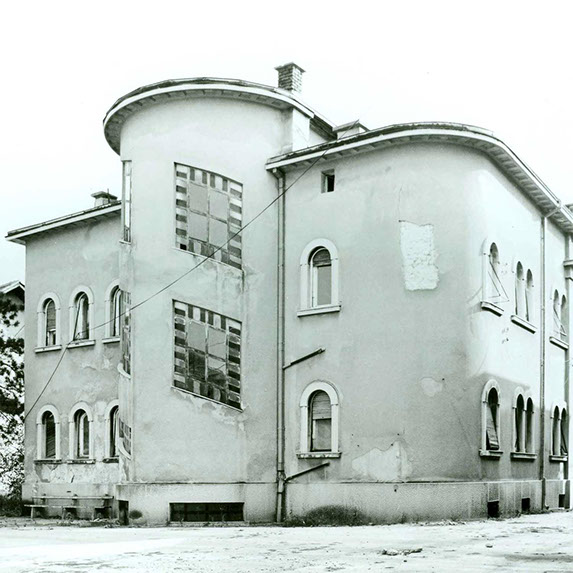
The ‘Klefish’ Villa was built in the 1930s as the family residence of Teodor Klefish, within the grounds of a food production factory. It has a rectangular base and consists of a basement, ground floor, first floor, and attic. The villa is constructed from brick and reinforced concrete. The plinth is finished with polished fine-grained terrazzo, while the main facade is plastered and adorned with stone grit. The central portal is covered with marble slabs and has an arched vault, with two columns on either side of the door featuring simplified Doric elements in the capitals and stylobates. The windows are arched, designed as trifores and bifores (on the upper floor), while on the ground floor they are in the shape of a semi-circle. The carpentry is wooden with arched muntins and fine wooden grilles. The window frames are outlined with sillstones, semi-circular blind pilasters, and semi-circular jambs. This window decoration is made of polished white cement with smoothed edges to create the appearance of stone blocks. The majority of the building is accentuated with horizontal cornices made of polished terrazzo, combining gray and white cement. The terraces are enclosed with walls featuring central openings, into which concrete balusters are set. One part of the attic floor has a walkable terrace with a pool. The roof is flat, covered with galvanized sheet metal, and has a deep console cornice made of reinforced concrete.
VILLA ‘KLEFISH’
On the western side of the facade, there is a marble memorial plaque commemorating the victims of World War II, specifically the workers of the ‘Juhor’ factory.
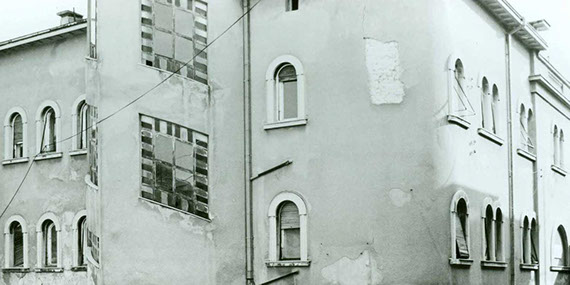
The interior of the building is also representative and richly decorated, particularly on the ground floor, which was used for receiving guests, business meetings, and various cultural events. The floors are made of Italian mosaic ceramics, while the floors in the side salons are made of parquet mosaic in the form of geometric patterns. The walls are smooth, and the ceilings are finished with shallow plaster molding and plaster rosettes in the center. A well-structured, circular staircase made of reinforced concrete, covered with white marble slabs, leads from the ground floor to the upper floors. The staircase is illuminated from the outside by windows made of metal, with stained glass in a mosaic pattern. On the upper floor, there are rooms for living and guest accommodation, and, if necessary, for receptions. The upper floor rooms are somewhat less decorated on the walls and ceilings, but the floors are made of parquet mosaic. The attic houses rooms for staff as well as auxiliary rooms for maintaining the building.
The central part of the attic is under a flat roof, while the sides of the building have a slight slope and are covered with sheet metal.
The ‘Klefish’ Villa was designated as a cultural monument by the Decision of the Government of the Republic of Serbia, number 633-6872/2001-11, dated July 17, 2001
(Official Gazette of the RS, number 46, dated July 27, 2001).
Site Map
Cultural Heritage by Type
Cultural Monuments
Notable Sites
Archaeological Sites
Spatial Cultural-Historical Units
Cultural Heritage by Location

60 years of the Cultural Heritage Preservation Institute Kragujevac
Copyright Cogent 2016. All Rights Reserved – Cultural Heritage Preservation Institute Kragujevac