
PARAĆIN
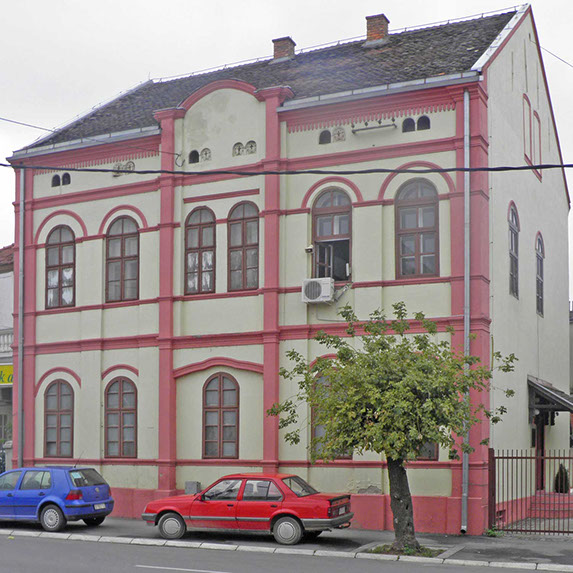
At No. 17 Tome Živanovića Street (formerly Maksima Gorkog) in Paraćin stands the so-called ‘Ružić Building’, which today houses the Paraćin Homeland Museum.
The building was constructed between 1870 and 1875 by Petar Ružić, a judge of the Paraćin court and a municipal councilor. Petar Ružić was a strong advocate for the development of education in Paraćin, and at his request, the Ministry of Education approved the opening of the first two-grade gymnasium, ‘Realčica’, in 1878.
This building has frequently changed its purpose. During the early years of the Serbian-Turkish Wars (1876–1878), it was used as a small reception hospital. After the wars, the building housed some departments of the gymnasium as well as the Women's Craft School, founded by the ‘Circle of Serbian Sisters’ society around 1910. From 1919, it was once again used as a school until 1929, when it was taken over by the military. After World War II, the building underwent numerous changes in use until 1977, when the Municipal Assembly of Paraćin assigned it to the Homeland Museum.
This is one of the first multi-story buildings in Paraćin, constructed in a simplified Neo-Renaissance style. It consists of a high ground floor and an upper floor, with a basement beneath the courtyard section of the building. The ground floor is divided into two parts by a corridor that was originally a carriage passage from the street to the courtyard. This passage was later bricked up, replacing the large double doors with arched frames with a window of the same style and dimensions as the neighboring facade windows. The roof is gabled and covered with beaver-tail tiles.
THE BUILDING AT NO. 17
MAKSIMA GORKOG STREET
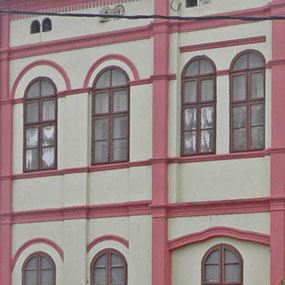
The street-facing facade of the building is decoratively treated with shallow stucco relief, painted in two tones. By incorporating slender semi-pilasters and elongated, arched windows, the building gains a visually heightened appearance. The verticality and symmetry of the structure are emphasized by a central risalit that cuts through the multi-profiled string courses, culminating in a semicircular finish above the roof cornice. On both floors, the rhythmically arranged slender arched windows appear in pairs on either side of the risalit. A touch of the national style is evident in the lace-like, Oriental ornamentation adorning the roof cornice on both sides of the central risalit of the street facade.
The building's interior is distinguished and well-preserved. Two painted ceilings and a medallion depicting a medieval warrior have been retained. The ceilings are adorned with geometric and floral motifs.
The Building at No. 17 Maksima Gorkog Street (Tome Živanovića nowdays) was designated as an immovable cultural heritage – cultural monument, by the Decision of the Municipal Assembly of Paraćin, No. 011-43/84-01, dated November 27, 1984.
Site Map
Cultural Heritage by Type
Cultural Monuments
Notable Sites
Archaeological Sites
Spatial Cultural-Historical Units
Cultural Heritage by Location

60 years of the Cultural Heritage Preservation Institute Kragujevac
Copyright Cogent 2016. All Rights Reserved – Cultural Heritage Preservation Institute Kragujevac