
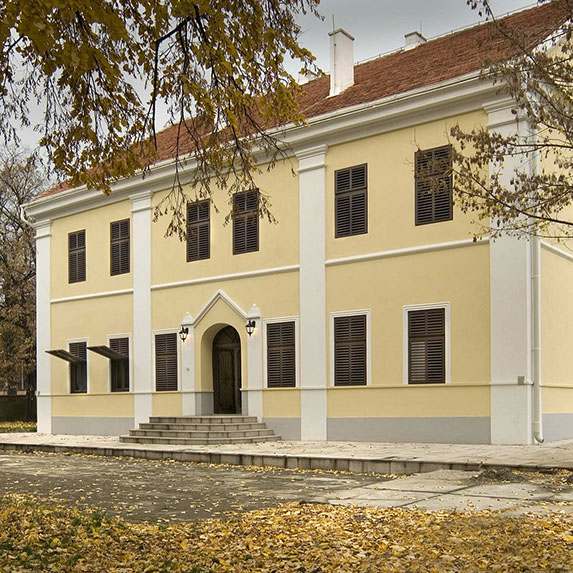
PRINCE MIHAILO'S RESIDENCE
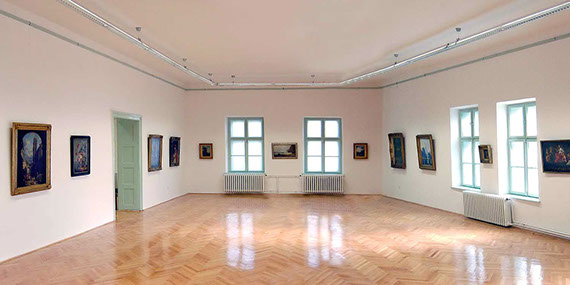
Prince Mihailo (Knez Mihailo in Serbian) was one of the most significant figures in our history. As part of the old Miloš's palace complex in Kragujevac, he built the Residence in 1860, which, along with the Amidža’s Residence and the modern gallery located in the courtyard, is now part of the National Museum of Kragujevac. It consists of a ground floor and an upper floor. The central part of the ground floor is marked by a spacious hall, which one enters immediately upon entering the building. From this hall, there are entrances on both the left and right sides into the spacious offices. The upper floor is almost identical to the ground floor. The interior is very modestly designed, with a lack of decoration. The roof is gabled, made of wooden construction and material.
The central entrance is slightly more elaborate, highlighted by a shallow gable above the entrance doors, which are reached by a modest staircase. The ground floor and the upper floor do not follow the same lines, so there are more windows on the ground floor than on the upper floor, but they are arranged in such a way that the entire ensemble is very harmonious.
In addition to the modest decorations on the central facade, which also features the entrance to the building, the other side facades are very modest, almost unrefined. Horizontal cornices and very subdued ornamentation make up almost the only decorations on the residence. This style of decoration in Prince Mihailo's Residence indicates a strong influence of Austrian architecture and art from the mid-19th century.
Older buildings from Miloš's time, some of which have been preserved in this area, differ in style, characteristics, and architecture from the newly built residence of Prince Mihailo.
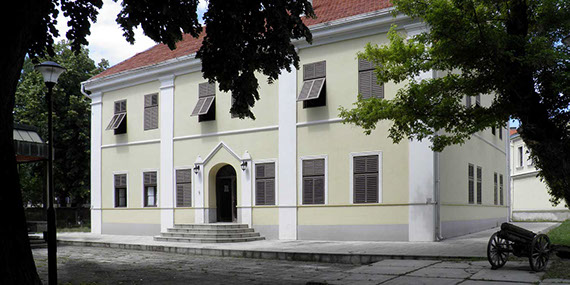
Prince Mihailo's Residence in Kragujevac was declared a cultural monument by the Resolution of the Institute for the Protection and Scientific Study of Cultural Monuments of Belgrade, No. 447/47, dated October 28, 1947, and was classified as a cultural heritage of great importance for Serbia on April 7, 1979, ‘Official Gazette of the RS,’ No. 14/79.
On them, the influence of the Turkish Balkan-Oriental style was clearly reflected, with characteristics of Eastern architecture, while now in the same space there was a completely new one, which fundamentally differed from the entire space. The building is a typical example of Western architecture, and a symbol of the cultural, modest restraint of the commissioner himself.
Site Map
Cultural Heritage by Type
Cultural Monuments
Notable Sites
Archaeological Sites
Spatial Cultural-Historical Units
Cultural Heritage by Location

60 years of the Cultural Heritage Preservation Institute Kragujevac
Copyright Cogent 2016. All Rights Reserved – Cultural Heritage Preservation Institute Kragujevac