
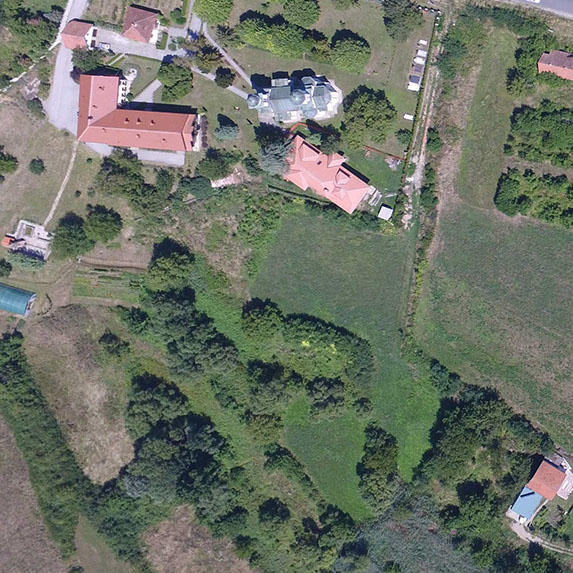
In the area between the church, school, and community center in the Village of Divostin, a prehistoric settlement was discovered in 1952 during a field reconnaissance by the Belgrade Archaeological Institute and the National Museum in Kragujevac. Several years later, in 1956, during construction works, locals discovered a group of figurines, ceramic vessels, and a three-legged altar. Further analysis revealed that this was a closed find from a room of a Vinča house with a specially designated cultic area. The figurines represent women, modeled rather roughly, with polygonal heads, prominent noses, and the lower part reduced to a pillar-like leg.
In 1959, the National Museum in Kragujevac conducted minor excavations, confirming the existence of a substantial Vinča material in this area. Despite the great interest the finds from Divostin attracted both locally and globally, further work resumed on a smaller scale only in 1967. In 1968, Divostin was studied as part of the large Yugoslav-American project ‘Early Agricultural Cultures in Central Serbia’. By 1971, 2250m² of Neolithic settlements in Divostin had been excavated, revealing over 100,000 items made of fired clay, flint, stone, and animal bones. The settlement covered an area of over 15 hectares and was inhabited during the earlier and final stages of the Neolithic, i.e., during the Starčevo and Vinča-Pločnik cultures.
PREHISTORIC SETTLEMENT
IN THE VILLAGE OF DIVOSTIN
Dr. Milenko Bogdanović and Prof. Dr. Dragoslav Srejović, based on the horizontal stratigraphy of ceramic finds within the Starčevo culture, distinguished the following phases:
- Divostin 1 – the oldest phase, characterized by small above-ground huts, unadorned ceramics, and rare anthropomorphic figurines.
- Divostin 1b – settlements of the pit-house type, impressed and sporadically painted ceramics, and zoomorphic figurines.
- Divostin 1c – distinguished by the appearance of above-ground rectangular houses, barbotine and painted ceramics, and cylindrical anthropomorphic figurines.
- The layer of the Vinča-Pločnik settlement is divided into two phases: Divostin 2a and Divostin 2b – Massive houses made of wood and earth, with areas up to 90 m² in some cases. Over 400 whole ceramic vessels were found, along with a large number of anthropomorphic figurines, altars, weights made of fired clay, and stone and flint tools.
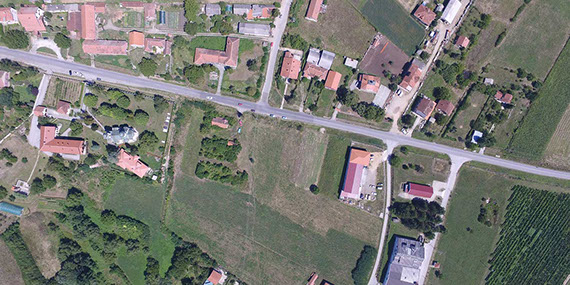
The prehistoric settlement in the Village of Divostin was designated as a cultural heritage – archeological site, by the Decision of the Cultural Heritage Preservation Institute Kragujevac, No. 227/1-68, dated March 18, 1969.
Site Map
Cultural Heritage by Type
Cultural Monuments
Notable Sites
Archaeological Sites
Spatial Cultural-Historical Units
Cultural Heritage by Location

60 years of the Cultural Heritage Preservation Institute Kragujevac
Copyright Cogent 2016. All Rights Reserved – Cultural Heritage Preservation Institute Kragujevac