
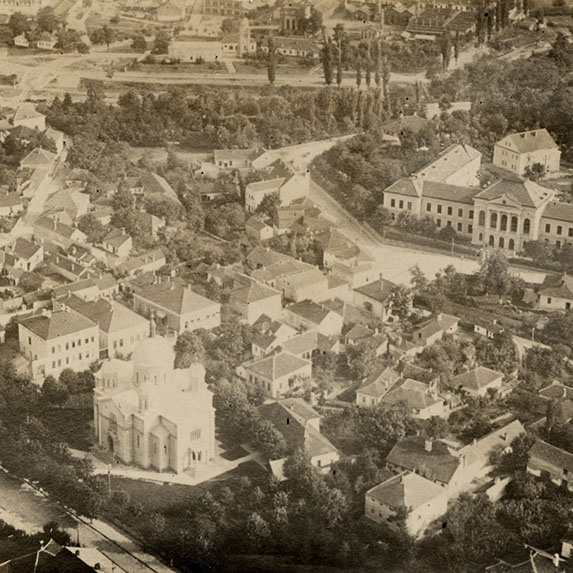
During the 19th century, from 1818 to 1841, Kragujevac was also the capital of Serbia. Prince Miloš Obrenović (Serbian Knez Miloš Obrenović) laid the foundations for the new city. Streets were straightened and paved, the course of the Lepenica River was regulated, and green spaces were established. The first city regulation plan was made in 1891, which shaped the new, modern appearance of the city, and Kragujevac became a new commercial, cultural, and public center. The urban plan from 1931 addressed the central city structure as well as key buildings in the city. The square near the ‘Krst’ (Cross) was the central core from which craft workshops, shops, stores, hotels, and inns spread. The city center was a very important segment for the further expansion of the city.
OLD TOWN CENTER
The Old Town Center was designated as a cultural heritage – spatial cultural-historical unit, by the Decision of the Cultural Heritage Preservation Institute Kragujevac, No. 258/1, dated June 16, 1970. It was categorized as a cultural heritage – spatial cultural-historical unit of great importance by the Decision of the Assembly of the Socialist Republic of Serbia on April 7, 1979 (‘Official Gazette of the SRS’ No. 14/79).
Site Map
Cultural Heritage by Type
Cultural Monuments
Notable Sites
Archaeological Sites
Spatial Cultural-Historical Units
Cultural Heritage by Location

60 years of the Cultural Heritage Preservation Institute Kragujevac
Copyright Cogent 2016. All Rights Reserved – Cultural Heritage Preservation Institute Kragujevac