
ĆUPRIJA
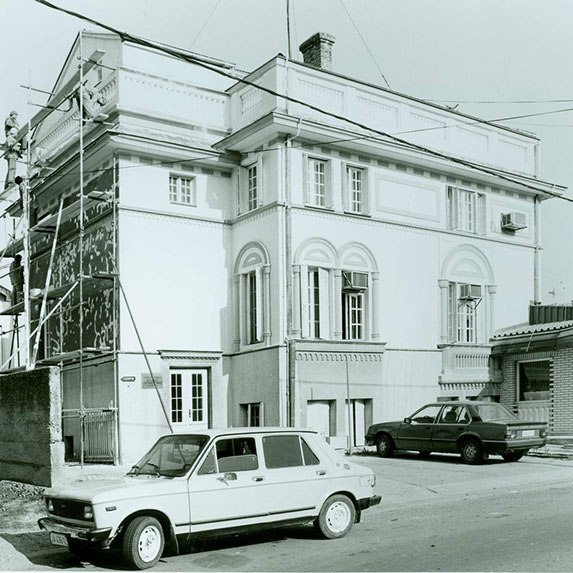
This building was erected at the end of the third decade of this century by Dr. Živojin – Žika Popović, a doctor, then director of the Ćuprija hospital, and a national parliamentarian. It was used as a residential building until April 5, 1961, when Dr. Popović handed it over to the Electric Distribution Company for their administrative purposes. The main designer of this house, in 1929, was the construction engineer Grigorije Vukićević from Belgrade.
The building has a rectangular base, with a basement, ground floor, and upper floor. It is built of stone, brick, and reinforced concrete. The facade is horizontally divided into three zones, with the lowest made of artificial stone blocks and rising above two meters. The second zone of the facade is separated by a cornice of shallow blind arcades from the third, last section.
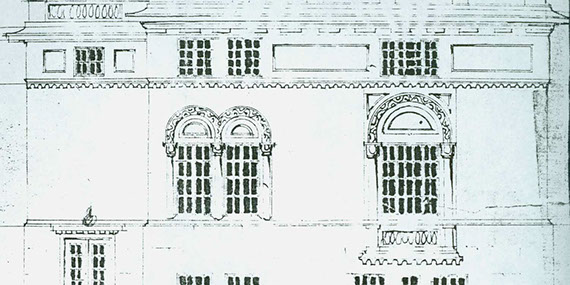
The windows rest on the lower edge of each section, with the basement windows almost at ground level. The most prominent windows on the street-facing facade are those of the ground floor, decorated with shallow relief plastic. The windows are not symmetrically placed and vary in size, with one being wider and the other being double.
THE HOUSE AT NO. 10
JOVANA KURSULE STREET
The House at No. 10 Jovana Kursule Street in Ćuprija was declared a cultural heritage – cultural monument, by the Decision of the Government of the Republic of Serbia No. 633-6872/2001-12 dated July 17, 2001, published in the Official Gazette of the Republic of Serbia No. 46 on July 27, 2001.
The windows on both sides are flanked by small half-pilasters with stylized Corinthian elements in the capitals and stylobates, on which the arches of the blind arcades rest.
The windows in the third zone are quite modest, without any decoration, while the free parts of the facade are filled with rectangular sections made of plaster. This section ends with a frieze and a roof cornice, above which is an attic that conceals the four-sided roof.
The interior of the building somewhat corresponds to the external impression. The rooms near the entrance have high ceilings, are spacious and bright, while the entrance hall is small and dark. The layout on the upper floor is dysfunctional due to the large central hall, which is also dim, from which one enters smaller rooms.
This building is a stylistic blend of neoclassicism (frieze, pilasters, and attic) and our national features—romantic elements from the 19th century.
Site Map
Cultural Heritage by Type
Cultural Monuments
Notable Sites
Archaeological Sites
Spatial Cultural-Historical Units
Cultural Heritage by Location

60 years of the Cultural Heritage Preservation Institute Kragujevac
Copyright Cogent 2016. All Rights Reserved – Cultural Heritage Preservation Institute Kragujevac