
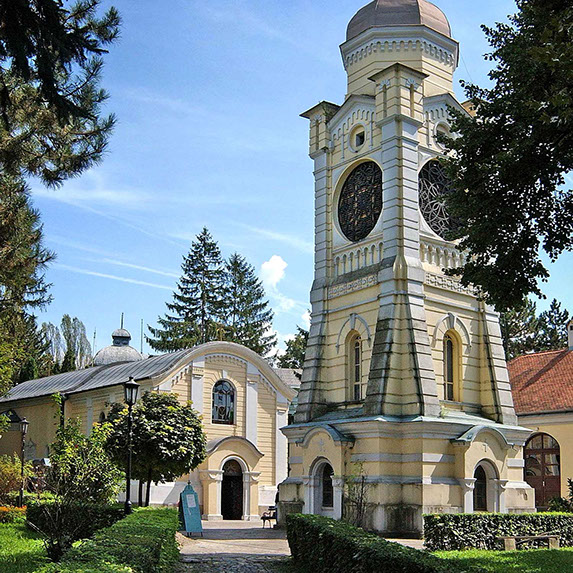
Upon coming to power, Prince Miloš (Serbian Knez Miloš) wanted to especially revive churches in Serbia and give them new splendor. With the proclamation of Kragujevac as the capital, it became necessary to build an Orthodox church, which would serve as a support and gathering place, as well as a venue for making important decisions by Serbian nobles. The construction of the Old Church began in 1818, with the decision made a year earlier. It was built on the left bank of the Lepenica River, and it was connected to Miloš's Wreath by a wooden bridge, known as Ćuprija. Over the years, the bridge was destroyed and rebuilt several times, and finally, in 1927, a concrete pedestrian bridge was erected at that location. The church is dedicated to the Holy Spirit and was built in the style of Slavonian and Vojvodinian churches. It is small in size, but the regulations under which an Orthodox church could be built at that time were very clear. The church had to be smaller than the mosque, which was located in close proximity.
The Old Church was built on the site where a cemetery once existed. This is evidenced by tombstones that were embedded in the church's foundations. The construction of the church itself was completed in 1820, and the entire complex, with a fully furnished interior and iconostasis, was completed in 1829. The main builder of the church is said to be Milutin Gođevac. There are records suggesting that he came to Serbia from Bosnia, and his birth year is mentioned as 1770. The interior was worked on by Giuseppe di Antonio, or ‘Italian Antonio’. His main assistant was also mentioned as Martin, but little is known about him.
THE OLD CHURCH IN KRAGUJEVAC
It served as the metropolitan cathedral, palace chapel, and court church. It is a small, single-nave building, combined with a triconch. The church has a rectangular base, with two side apses and one central apse. It is vaulted with a semi-dome. It is built from rubble stone. A marble founder's inscription can be found on the northern wall.
The church is not frescoed, but the iconostasis, made by the same masters from Ravanica, Kalenić, and Voljavča, is of great value. At one point, the interior housed nine silver candlesticks and two crystal chandeliers.
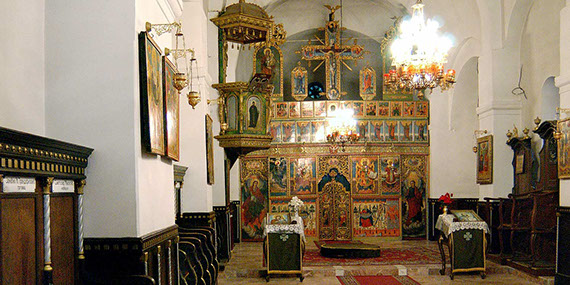
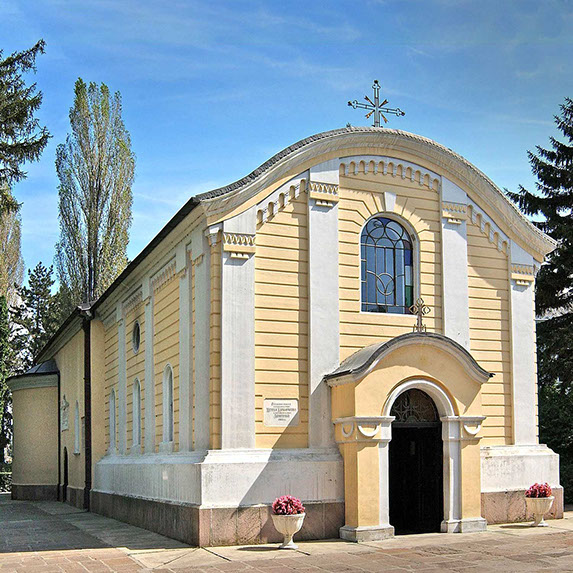
The Old Church, together with the Old Assembly in Kragujevac, was designated as a cultural monument by the Decision of the Institute for the Scientific Study of Cultural Monuments in Belgrade, No. 1410, dated September 26, 1958, and classified as a cultural heritage of great importance for the Republic of Serbia in the ‘Official Gazette of the Republic of Serbia’, No. 14/79, dated April 7, 1979.
In 1907, when the old wooden narthex was replaced with a new stone one, the church also received a bell tower. As a masterpiece of this area, along with the new narthex, the bell tower was designed by Jovan Ilkić, who, along with Svetozar Ivačković and Vladimir Nikolić, was a student of Theophil Hansen, a representative of Neo-Byzantine art. Ilkić's bell tower made a significant contribution to the development of the national style in Serbian architecture. It was his last work in the spirit of Hansen's Neo-Byzantine art in Kragujevac. In the ground floor of the bell tower, there are ornate supporting columns, and at the very top, there are turrets and spires. The entire bell tower is quite ornate and burdened with stylized ornaments. At the very top, there are cubic turrets with pediments, and an octagonal dome at the apex. In the center of the rectangular field are rosettes.
Site Map
Cultural Heritage by Type
Cultural Monuments
Notable Sites
Archaeological Sites
Spatial Cultural-Historical Units
Cultural Heritage by Location

60 years of the Cultural Heritage Preservation Institute Kragujevac
Copyright Cogent 2016. All Rights Reserved – Cultural Heritage Preservation Institute Kragujevac