
PARAĆIN
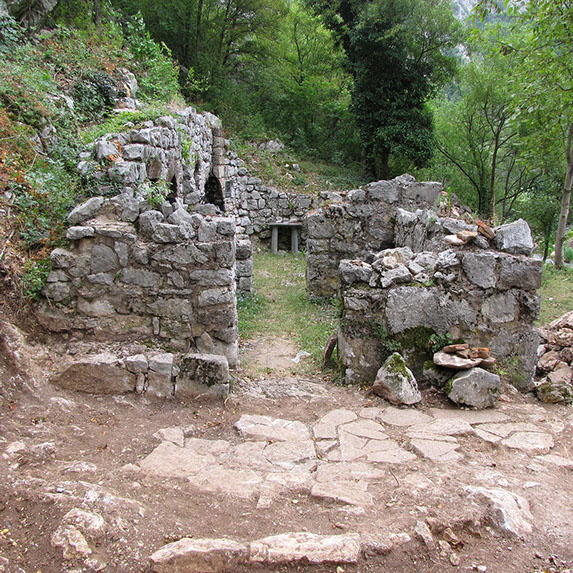
The remains of the Monastery of the Beheading of St. John the Baptist are located on the left bank of the Crnica River. Between 1972 and 1975, the remains of a single-nave church with a later added narthex were discovered at this site, with overall dimensions of 11m × 4.4m. The walls, preserved to a height of 1.50m to 2.90m, were built from hewn and roughly hewn stone in lime mortar. Based on the discovered stone blocks, it was concluded that the church had been vaulted with a semi-domed roof. As part of a project by the Institute for the Protection of Cultural Monuments in Kragujevac, archaeological research was conducted in the churchyard in 2010 and 2011. West and south of the church, there are two buildings, each containing two rooms. These buildings were constructed in two levels, utilizing the terrain's steep slope toward the river. The rooms housed cells, a dining hall, and economic spaces. The monastery complex was enclosed by a wall built from rough stone, which had been modified multiple times and protected the monastery from the waters of the Crnica River. The construction of the monastery dates to the late 14th century, possibly the early 15th century.
THE CHURCH OF THE BEHEADING OF
ST. JOHN THE BAPTIST, ZABREGA
Bibliography:
- Marin Brmbolić, Mala Sveta gora u klisuri reke Crnice, Republički zavod za zaštitu spomenika kulture, Beograd 2011.
- Radoslav Prokić, Srednjovekovna arhitektura petruške oblasti, Zavod za zaštitu spomenika kulture Kragujevac, Kragujevac 1986.
- Svetlana Popović, Krst u krugu, Republički zavod za zaštitu spomenika kulture Beograd, Beograd 1994.
- Marija Kaličanin-Krstić, Arheološka istraživanja manastirskog kompleksa Svetog Jovana Glavoseka, Saopštenja XLIV – 2012, Republički zavod za zaštitu spomenika kulture Beograd, Beograd 2012, 249-259
- Feliks Kanic, Srbija, zemlja i stanovništvo, knjiga 2, Beograd 1991; ponovljeno izdanje: Srbija, zemlja i stanovništvo od rimskog doba do kraja XIX veka, druga kiga , LOGOS ART, Beograd, 2007
- Svetlana Popović, Krst u krugu, arhitektura manastira u srednjovekovnoj Srbiji, Prosveta, Republički zavod za zaštitu spomenika kulture, Beograd, 1994.
- B. Cvetković, Kamena rozeta iz manastira Sv. Jovana Glavoseka, Saopštenja XXXIV-2002, Republički zavod za zaštitu spomenika kulture Beograd, Beograd 2002
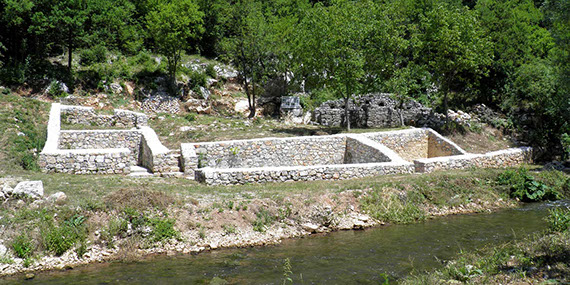
The Church of the Beheading of St. John the Baptist in Zabrega was designated as a cultural heritage – cultural monument, by the Decision of the Cultural Heritage Preservation Institute Kragujevac, reference number 358/1, dated June 30, 1975. It was also classified as an immovable cultural heritage of great importance by the Decision of the Assembly of the Socialist Republic of Serbia on July 21, 1983 (‘Official Gazette of the SRS’ No. 28/83).
Site Map
Cultural Heritage by Type
Cultural Monuments
Notable Sites
Archaeological Sites
Spatial Cultural-Historical Units
Cultural Heritage by Location

60 years of the Cultural Heritage Preservation Institute Kragujevac
Copyright Cogent 2016. All Rights Reserved – Cultural Heritage Preservation Institute Kragujevac