
DESPOTOVAC
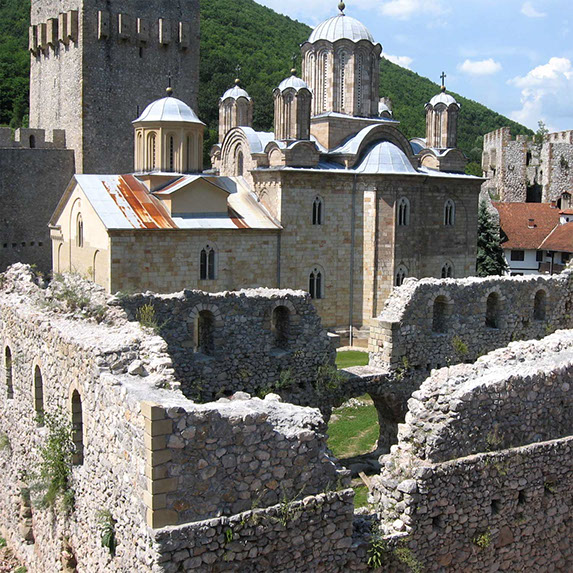
The endowment of Despot Stefan Lazarević, the Manasija Monastery, was built between 1407 and 1418. As a significant artistic center, Manasija serverd during the first half of the 15th century, as a literary hub where renowned Resava School operated for many years, influencing regions for beyond the borders of Serbia.
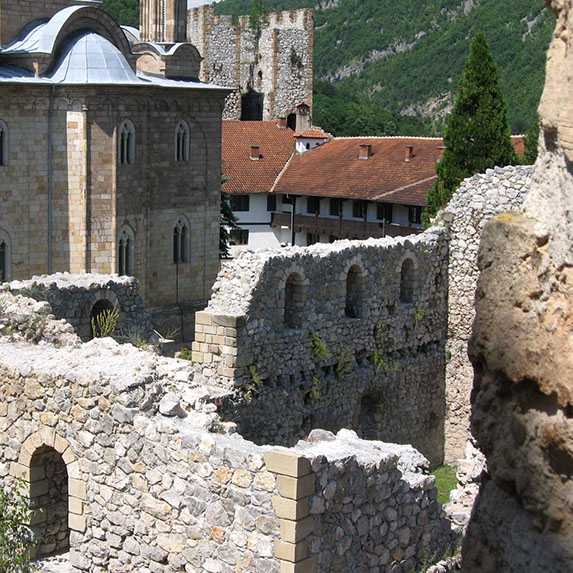
The monastic complex consists of the church, remnants of an old library, residential quarters, and a robust fortress with 11 towers and a keep, among which Despot's Tower stands out for its height and appearance. The church, dedicated to the Holy Trinity, follows the plan of an expanded inscribed cross combined with a trefoil design. It belongs to the Morava architectural school but differs from most of its contemporaries by being constructed from precisely cut stone blocks, with no ceramic-plastic polychromatic facade decorations.
In the narthex, a unique mosaic floor has been preserved, composed of multicolored stone tiles forming a cross with a decorative rosette.
The most beautiful adornment of Manasija is its frescoes.
Despite severe damage, this collection of frescoes ranks among the most significant achievements of Serbian medieval painting.
MANASIJA MONASTERY NEAR DESPOTOVAC
In the dome, the frescoes depict the figures of great prophets, while the small domes feature angels, and the pendentives display the Evangelists. The apse showcases the Communion of the Apostles and the Adoration of the Lamb, while the altar contains several Old Testament scenes and individual saints. The choir areas depict holy warriors and compositions of Christ's parables. On the columns, there is the Vision of Peter of Alexandria, individual saints, and archangels. The western wall is adorned with the Dormition of the Virgin and a portrait of Despot Stefan holding a model of the church. On the other walls of the church, remnants of medallions with busts of saints, individual figures, and fragments of scenes from the cycles of Great Feasts, Miracles, and the Earthly Life of Christ can be found.
The figures are well-proportioned and elegant, with a confident drawing style and exceptional modeling. Among the anonymous masters who frescoed the church of the Manasija Monastery, there were undoubtedly several outstanding icon painters who, in terms of artistic merit, can be compared to the greatest painters of the 15th century.
With its powerful fortifications, towers, church architecture, extraordinary frescoes, and old monastic quarters, Manasija ranks among the most well-preserved medieval monastic complexes.
The Monastery was designated an immovable cultural heritage – cultural monument, by the Decision of the Institute for the Scientific Study of Cultural Monuments, Belgrade, under reference number 301/48 on March 5, 1948. It was later classified as a cultural heritage of exceptional importance by the Decision of the Assembly of the Socialist Republic of Serbia (‘Official Gazette’ SRS No. 14/79, dated April 7, 1979).
Site Map
Cultural Heritage by Type
Cultural Monuments
Notable Sites
Archaeological Sites
Spatial Cultural-Historical Units
Cultural Heritage by Location

60 years of the Cultural Heritage Preservation Institute Kragujevac
Copyright Cogent 2016. All Rights Reserved – Cultural Heritage Preservation Institute Kragujevac